Clause
AI contract review that checks every agreement against the firm's own playbook.
- Client
- Clause
- Industry
- Legal tech
- Location
- New York, NY
- Services
- Product strategy, UX research, SaaS web app design, AI interaction design, Design system, Front-end development
- Year
- 2026
- Project
- Self-initiated concept
Overview
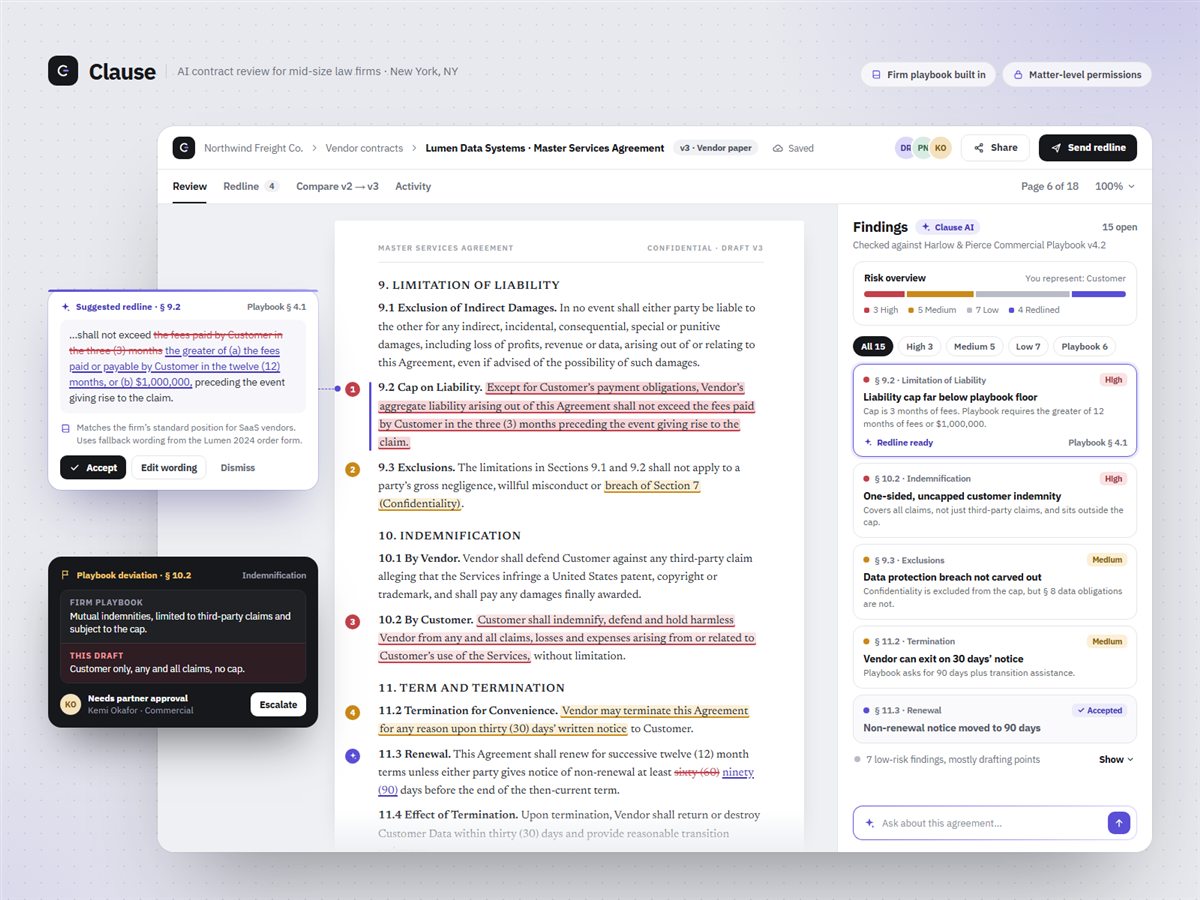
A contract-review workspace for mid-size New York law firms: upload an agreement, see risky clauses highlighted on the page, compare them with the firm's playbook, accept suggested redlines and route the result for partner sign-off.
The challenge
Clause's founding firms were reviewing vendor paper the slow way: a Word document, a PDF playbook in another window and redlines traded by email. Generic AI tools flagged everything as risky and wrote edits nobody could trace back to firm policy, so partners didn't trust them. The product had to feel like a careful associate, not a chatbot, and every change had to show where it came from.
What we did
- 01
Kept the contract at the centre of the screen as a real page, with risk shown as quiet highlights and numbered margin pins, and a findings panel beside it sorted by severity and tied to the firm's playbook section.
- 02
Gave AI output its own restrained language: an iris spark mark, an iris tint for suggested wording and a thin gradient edge on AI cards, so lawyers can always tell a Clause suggestion from their own edits.
- 03
Designed suggested redlines and playbook deviations as small cards that sit next to the clause they refer to, each with the firm's position, the draft's position and a clear accept, edit or escalate action.
- 04
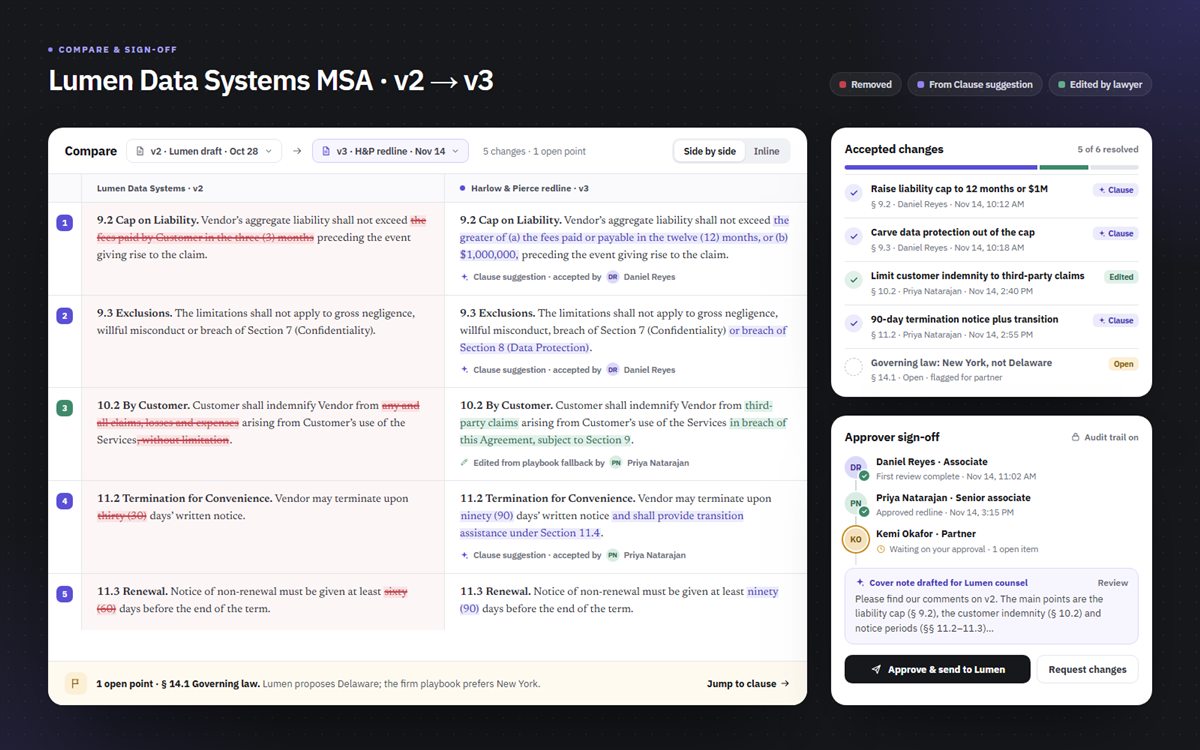
Built a side-by-side compare view where every change carries its source and who accepted it, plus an approver sign-off trail from associate to partner before anything goes back to opposing counsel.
Design system
Graphite
#17181C
Iris
#5B4FD6
Rosewood
#C2414B
Ochre
#C98A1B
Fog
#E8E9EE
Display · IBM Plex Sans
Aa
Text · Newsreader
The quick brown fox jumps over the lazy dog.
The design aims to make first-pass review faster without hiding the reasoning, keep every redline traceable to firm policy and a named lawyer, and give partners one calm place to approve a contract before it leaves the firm.